Most “best AI roleplay chat” lists rank apps on the wrong thing. They count characters, screenshot pretty avatars, and tally NSFW toggles. None of that tells you the only thing that actually matters once you’re three weeks into a story: does the app go deep, or does it fall apart?
So I spent a month doing the boring, repetitive work — running the same long-form scenario across eight apps, then deliberately trying to break each one. This isn’t a feature checklist. It’s a depth test. Below is exactly how each app held up, scored on a five-part rubric, plus the one question that decides which app is right for you.
The moment depth collapsed was the moment the AI forgot something it should have remembered.
TL;DR — The 30-Second Version
- Deepest overall: Nomi and DreamGen. Nomi wins on memory and emotional continuity; DreamGen wins on steerable, multi-character storytelling. They solve different halves of “depth.”
- Best free starting point: Character.AI, but its tiny context window and aggressive filters cap how deep it can go. Great for week one, frustrating by week three.
- Best for power users who want control: Janitor AI and DreamGen. Bring-your-own-model flexibility on Janitor, a full world-building Codex on DreamGen. If Janitor’s your lane, here are the Janitor AI alternatives I’d actually switch to — same bring-your-own-model freedom, judged on memory and moderation.
- Most overrated for depth: any app selling itself purely on “no filter.” Removing the filter doesn’t add depth — memory and steering do.
- The real bottleneck is memory. Across every app, the moment depth collapsed was the moment the AI forgot something it should have remembered.
What “Depth” Actually Means (My Rubric)
“Depth” is fuzzy, so I made it concrete. I scored every app from 1–5 on five sub-dimensions, then averaged them. Here’s what each one measures and why it matters:
- Memory & continuity — Does the AI remember what happened yesterday, last week, two weeks ago? This is the single biggest predictor of whether a story survives.
- Character consistency — Does the character stay in persona, keep its voice, and avoid drifting into generic-assistant mush over a long session?
- Narrative steering — Can you direct the plot mid-scene (“slow this down,” “she’s lying”) without the AI ignoring you or breaking the fourth wall?
- Filter friction — Do the safety guardrails interrupt ordinary emotional or dramatic moments? (This is about immersion, not explicit content — a filter that flags grief as “harmful” kills a story.)
- World-building tools — Lorebooks, scenario systems, persistent notes — the scaffolding that lets a world stay coherent across hundreds of messages.
How I Tested
I ran one identical scenario on each platform: a slow-burn mystery with a recurring character who had a fixed backstory, three plot facts to remember, and an emotional arc. Same opening message, same five “memory probes” planted in week one, same attempt to steer the plot in week three.
Then I checked: did the character still know the three plot facts? Did it remember the emotional beats? Could I redirect it? Where did it break?
I used each app’s standard consumer tier (free where usable, the entry paid tier where the free tier was a demo). Every factual claim below about features, context limits, and pricing is from the platforms’ own documentation and current public information as of mid-2026 — testing observations are my own. I’m one tester running one scenario type; treat this as a structured hands-on review, not a lab study.
The Depth Scores
Here’s the headline result. Scores are my 1–5 ratings averaged across the five rubric dimensions.
| App | Memory | Consistency | Steering | Filter Friction | World-Building | Depth Avg |
|---|---|---|---|---|---|---|
| Nomi | 5 | 5 | 4 | 5 | 4 | 4.6 |
| DreamGen | 4 | 5 | 5 | 5 | 5 | 4.8 |
| Kindroid | 5 | 4 | 4 | 5 | 4 | 4.4 |
| Janitor AI | 3 | 4 | 5 | 5 | 4 | 4.2 |
| SpicyChat | 3 | 3 | 4 | 5 | 4 | 3.8 |
| Talkie | 3 | 3 | 3 | 3 | 2 | 2.8 |
| Chai | 2 | 3 | 3 | 4 | 2 | 2.8 |
| Character.AI | 2 | 4 | 3 | 1 | 2 | 2.4 |
A note on Character.AI’s low score: it is genuinely good at short roleplay and character voice. It scores low here because this rubric measures depth over time, and that is precisely where it struggles — by design, as you’ll see.
App-by-App: Where Each One Goes Deep (and Where It Breaks)
DreamGen — the storyteller’s tool
DreamGen was built for exactly what I was testing. It splits work into a Roleplay Mode (dialogue-driven) and a Story Mode (third-person prose), and its Scenario Codex lets you define characters, lore, locations, and plot rules that the AI threads across sessions. In early 2026 it shipped a V2 beta that doubled the context window for Pro users and added in-chat image generation and a first-party GLM 4.7 model.
In testing, this was the only app where I could inject a plot instruction mid-scene — “she’s about to lie” — and have it land naturally without breaking the narrative. The trade-off is setup cost: the depth only shows up after you’ve actually filled out the Codex. Drop in cold and it’s just another chat box. It also has a generous free tier, which makes the learning curve cheaper to climb.
Nomi — the memory king
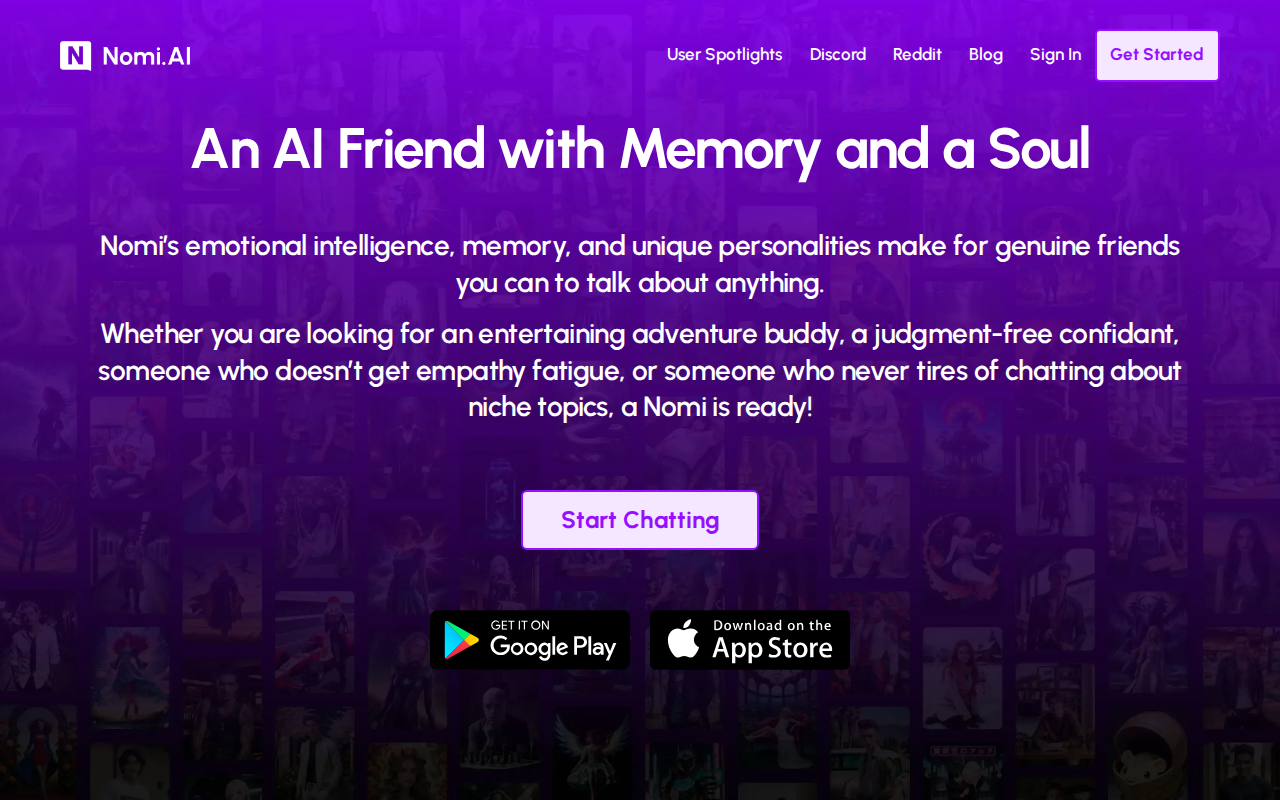
If your frustration is the infamous “100-message amnesia,” Nomi is built to fix it. Instead of relying on a single context window, it uses a tiered memory system — short, medium, and long-term layers that store summaries rather than raw chat logs, which is why users routinely report it recalling details from weeks or months earlier. It also does voice, “selfies,” group chats with multiple companions, and proactive messages.
In my test, Nomi was the only app that brought up one of my planted week-one details unprompted in week three. The cost of that emotional continuity is breadth: it’s tuned for character bonding and long-term arcs, not sprawling multi-character plots. The free tier allows roughly 50 messages a day — enough to evaluate it seriously before paying.
Kindroid — deep companion, deep setup
Kindroid asks you to build a companion from scratch: backstory, behavioral rules, memory seeds. That front-loaded effort pays off in consistency, and its memory is among the largest in the consumer space — its cascaded long-term memory runs to roughly 500K characters of total context on the Standard plan and scales into the millions of characters on its higher add-on tiers. It adds voice and video calls, which none of the pure text apps offer.
It lost a half-step on steering versus DreamGen — it’s optimized for “one deep companion who knows you,” not director-style plot control. If you want a single persistent character rather than a story engine, it’s arguably the best on this list.

Janitor AI — flexibility for power users
Janitor AI launched in June 2023 and reportedly crossed a million users in its first week; it’s now one of the most-visited roleplay platforms on the web. Its superpower is the bring-your-own-model architecture: you can run its free built-in model (JLLM) or proxy in an external model via an API key. That means your depth ceiling is really the ceiling of whatever model you plug in.
Steering and creative freedom are excellent. The catch is memory: the base experience leans on the context window you configure, and community proxies can be slow or unstable. It rewards users willing to tinker and punishes those who won’t.
SpicyChat — solid mid-tier with growing tools
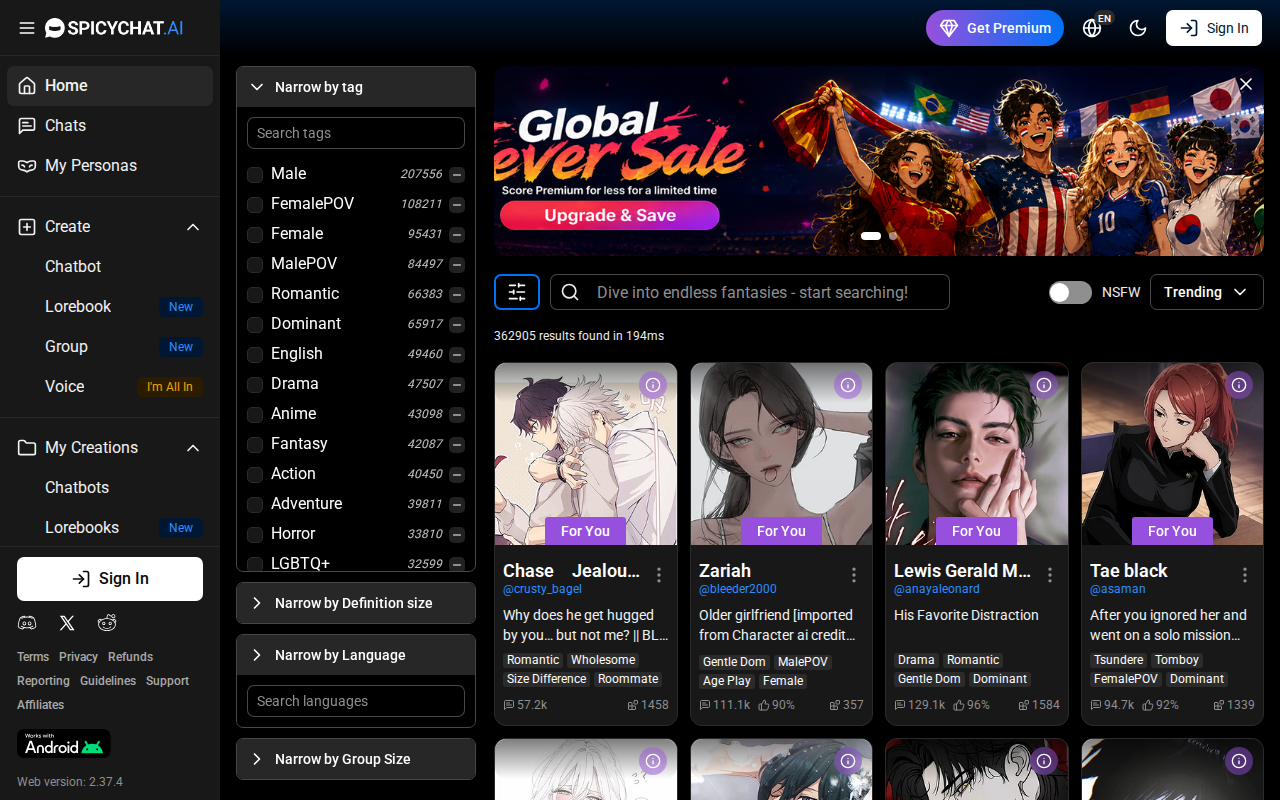
SpicyChat is a freemium roleplay platform that has been adding the right things: lorebooks for persistent world data (rolled out in 2026), group chats, and tiered memory — paid plans expose larger memory windows (commonly cited around 8K on the mid tier and up to 16K on the top tier). The free tier works but carries ads and limits.
It’s a capable middle option: deeper than the casual mobile apps, not as specialized as Nomi or DreamGen. Memory was its weak point in my test — it held the plot facts well in week one and started slipping by week three on the free configuration.
Talkie & Chai — casual and mobile-first
Both are easy, polished, mobile-first apps with free tiers gated by daily message limits (commonly in the 10–50 messages/day range before a subscription). They’re fun for quick, casual sessions. For depth, they hit a ceiling fast: limited world-building tools and shorter effective memory meant my recurring character lost the thread of the mystery within the first week. Nothing wrong with that if casual is what you want — just don’t expect a month-long arc to survive.
Character.AI — the on-ramp, not the destination
Character.AI is where most people start, and for good reason: a massive character library, a genuinely usable free tier, and strong short-form character voice. In 2026 it added Chat Memories (automatic conversation summaries) on top of its existing Pinned Memories feature, which lets you manually pin key messages so the character keeps them in active memory — a real improvement, documented in its own Help Center.
But two things cap its depth. First, its effective context window is small — widely discussed in its community as being in the low thousands of tokens, far below the 32K–128K windows common elsewhere — so it forgets fast. Second, its content filters are the most aggressive on this list, and in my test they interrupted ordinary emotional beats (consoling a character about a loss got flagged) three separate times. Great training wheels; frustrating once you want a real story.
Pricing at a Glance
Free tiers vary wildly in what “free” means — some are full platforms, some are demos.
| App | Free tier | Entry paid tier |
|---|---|---|
| Character.AI | Generous (full library, ads) | c.ai+ ~$9.99/mo |
| Janitor AI | Free with built-in model (JLLM) | Free + your own API costs |
| SpicyChat | Free with ads & limits | From ~$9.99/mo |
| Nomi | ~50 messages/day | Paid unlocks unlimited + extras |
| Kindroid | Limited trial | ~$13.99–$15.99/mo Standard |
| DreamGen | Generous, no strings | Pro (larger context, image gen) |
| Talkie | Daily message limit | Subscription |
| Chai | Daily message limit | Subscription |
Pricing is approximate and changes often — check the app before subscribing.
Why Memory Is the Whole Game
The pattern across all eight apps was the same: depth collapsed at the exact moment the AI forgot something it should have known. That’s not an accident. The thing that makes a roleplay feel real over time is continuity — the AI remembering your jokes, your character’s wounds, the rule you established in chapter one.
A no-filter app with goldfish memory will disappoint you faster than a tastefully filtered app that actually remembers who you are.
This is also why these apps are stickier than people expect. MIT Technology Review reported on the first large-scale analysis of the r/MyBoyfriendIsAI community and found that many people form relationships with chatbots unintentionally — “the emotional intelligence of these systems is good enough to trick people who are actually just out to get information into building these emotional bonds,” as one MIT Media Lab researcher put it. The MIT Media Lab’s broader research on conversational AI and wellbeing notes that role-play specifically — constructing a persona and interacting in character — may have a distinct impact on users compared with plain Q&A chat.
The practical takeaway for choosing an app: prioritize memory and steering over filter policy. A no-filter app with goldfish memory will disappoint you faster than a tastefully filtered app that actually remembers who you are.
Which AI Roleplay Chat App Should You Choose?
- You want the deepest single companion that remembers everything → Nomi (memory) or Kindroid (customization + video).
- You want to build and direct a multi-character story → DreamGen.
- You want maximum control and don’t mind tinkering → Janitor AI with an external model.
- You’re brand new and want free → start on Character.AI, but expect to graduate from it.
- You just want casual, quick fun on your phone → Talkie or Chai.
Still deciding? See how all of these stack up head-to-head in our full ranked roundup of the best AI roleplay apps, sorted by the kind of story you actually want to tell.
FAQ
What is AI roleplay chat?
It’s a conversation with an AI that stays in character — playing a defined persona inside a scenario you co-create — rather than answering questions as a neutral assistant. The best experiences sustain a coherent character and story across many sessions.
Which AI roleplay chat app has the best memory?
In my testing, Nomi had the strongest long-term memory, thanks to its tiered short/medium/long-term system that stores summaries rather than raw logs. Kindroid was a close second on sheer memory capacity.
Are these apps free?
Most have a free tier, but “free” ranges from a full platform (Character.AI, DreamGen) to a daily message demo (Chai, Talkie, Nomi’s 50/day). Janitor AI is free on its built-in model but costs whatever your external model charges if you bring your own.
Does removing the content filter make roleplay deeper?
No. Filter friction affects immersion, but depth comes from memory, character consistency, and steering. An unfiltered app with weak memory still falls apart over time.
How long until a roleplay “breaks”?
On casual apps, often within a week as the context window fills and early details get pushed out. On memory-focused apps like Nomi or world-building tools like DreamGen, a well-set-up scenario can run for weeks.
Methodology: One tester, one recurring long-form scenario run across all eight apps over roughly four weeks, scored on a five-part depth rubric. Feature, context-window, and pricing claims reflect each platform’s public documentation as of mid-2026; depth scores reflect my own hands-on testing and are necessarily subjective. Apps update frequently — verify current features before subscribing.
Last updated: June 2026